



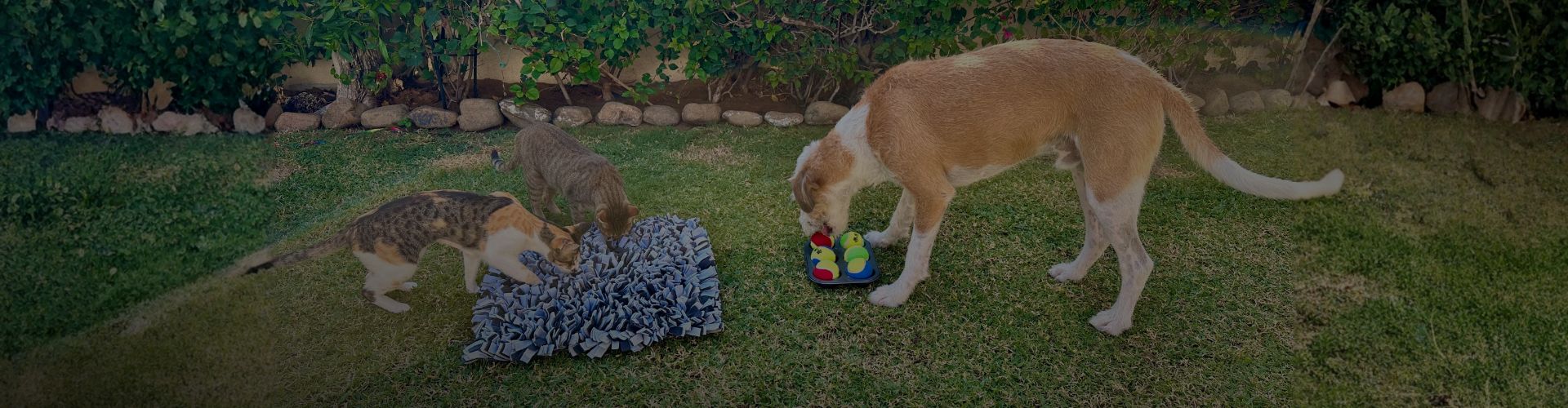
Rainy-Day Ideas to Keep Pets Busy
When the weather turns grey, energy doesn’t disappear—it redirects. For dogs and cats, boredom indoors can quickly turn into frustration, over-grooming, barking, or chaotic “zoomies.” The goal isn’t just to keep them busy; it’s to meet their natural needs for scenting, foraging, chasing, and problem-solving.
DIY enrichment games aren’t “filler activities.” They’re opportunities to create meaningful, instinct-based experiences using everyday items—yes, even something as simple as a muffin tin. When you design the game around real behavior patterns, the results are calmer, more confident pets.
This isn’t a random list of cute Pinterest ideas. This is a practical, expert-led approach to building enrichment that works because it connects to instinct—not aesthetics.
Understanding The Science Behind Enrichment
True enrichment engages at least one of four instinctual systems:
- Foraging and hunting – using nose, eyes, and paws to locate food.
- Manipulation – problem-solving with paws, mouth, or body.
- Social engagement – cooperative play or “shared” problem-solving with you.
- Sensory exploration – exposure to textures, sounds, and movement safely indoors.
When you design DIY enrichment around these systems, you stimulate the brain’s reward pathways in the same way a wild environment would. The result? A calmer, more fulfilled pet who doesn’t need constant redirection.
Setting Up Your Space: Controlled Chaos
Before crafting games, prepare your environment for success. Move furniture slightly to open up flow zones, use non-slip rugs, and establish a “play mat” or towel as a game zone. This space becomes a predictable signal: enrichment happens here. It keeps your home clean, and it anchors arousal to a single location, making post-play calm easier to achieve.
Use scent-free cleaning products between sessions so leftover food smells don’t attract obsessive searching. For cats, rotate locations weekly (kitchen, hallway, catio corner) to avoid territorial stress.
Game 1: The Scent Scatter Challenge
Targets: olfaction + foraging
Scatter feeding is simple, but powerful—done right, it becomes scent training for everyday pets.
Start by scattering part of your pet’s meal in an easy, visible pattern. Once they understand the task, increase complexity: hide treats under folded towels, behind furniture legs, or slightly under lightweight containers. Dogs and cats both experience reward from hunting the invisible.
The key is pacing. For anxious or high-drive pets, start small: one room, a handful of treats, calm music. Over time, create “zones” of discovery—each with its own scent profile (a few drops of valerian root water on one towel, catnip hidden in another).
This taps into deep scent work—a sensory form of mindfulness that resets overstimulated pets better than most toys.
Game 2: The Cardboard Labyrinth
Targets: manipulation + problem-solving
A pile of clean boxes can be the foundation of advanced enrichment. Cut entry holes of different sizes, connect a few with tape, and hide treats or toys inside. Cats will explore by stalking, sniffing, and ambushing. Dogs can nudge boxes aside, push their noses in, and problem-solve without destruction—if introduced properly.
The trick is to stage success.
Start with open boxes containing visible treats. Gradually close some flaps, or create multi-step “quests” where one treat leads to another box. Add shredded paper, tissue, or crinkled foil for texture.
For cats, cut small “windows” and let light filter through—it encourages visual tracking. For dogs, tape boxes to a heavy mat so the structure doesn’t topple.
Done thoughtfully, this game satisfies predatory curiosity and teaches persistence, patience, and body awareness indoors.
Game 3: DIY Snuffle Fabric Trail
Targets: scentwork + movement
If you don’t own a snuffle mat, you can make one from an old towel or fleece blanket. Fold and tie loose knots, tuck treats inside folds, and place the trail down a hallway or between furniture legs. Encourage your pet to move slowly along it, sniffing each section.
This linear scent trail keeps focus narrow and minimizes manic movement, making it ideal for rainy afternoons. For cats, sprinkle tiny bits of kibble mixed with silvervine or valerian root powder (not catnip for every cat—it overstimulates some). For dogs, use dry kibble for daily meals or low-crumb soft treats for special sessions.
You can progress this by layering textures—knotted fleece, crinkled parchment paper, cardboard—to mimic natural terrain.
Game 4: The Towel Burrito
Targets: sequencing + manipulation
Take a large towel, scatter treats along its length, roll it up gently, and tuck one end under. Your pet must unroll it to find the rewards.
This deceptively simple setup builds frustration tolerance and fine motor coordination. Start loose for beginners; tighten rolls as your pet masters it. For extra challenge, fold treats into layers like a croissant, or hide a favorite toy at the end.
What looks like play is actually controlled frustration training—a crucial emotional skill that helps pets cope with real-world stress, from grooming to travel.
Game 5: The “What’s Under Here?” Puzzle
Targets: cognitive decision-making + control
Line up three cups or small containers. Hide a treat under one and let your pet watch. Shuffle them slowly and ask, “Where’s the treat?” Dogs will use scent; cats often use gaze tracking.
If your pet chooses correctly, lift the cup and reward. If not, show them and reset without frustration. Over time, add an extra cup, vary container shapes, or mix scents.
This game strengthens working memory and self-control. For nervous pets, it builds confidence in problem-solving without punishment.
Game 6: Cat-Specific Vertical Enrichment
Targets: proprioception + observation
Rainy days often leave cats restless, not bored—they crave motion watching. Rearrange their vertical routes: add a temporary cardboard perch, move a scratching post near a window, or tape small tissue “flags” to flutter gently in drafts.
To layer enrichment, hide a few treats or toys in new heights—bookshelves, curtain edges (safe only), or atop cat trees. This triggers vertical foraging, an underused enrichment form that boosts confidence and muscle tone.
Rotate these every few days; cats thrive on “fresh layouts.”
Game 7: Cooperative Play With You
Targets: social bonding + energy release
Enrichment doesn’t always mean solo puzzles. Shared play releases oxytocin for both you and your pet, which can offset weather-induced irritability.
For dogs: tug games with clear cues (“take,” “drop”), or hide-and-seek around furniture. For cats: controlled wand play following prey sequence—stalk, chase, catch, kill (toy), eat (treat). End on calm licks or grooming.
The structure matters. Chaos burns energy; ritualized play builds trust and predictability, especially in multi-pet homes.
Creating Novelty With Rotation
Pets habituate quickly. What was thrilling on Monday may be dull by Friday. Instead of buying new toys, rotate your existing DIY setups. Box maze on Week 1, towel burrito on Week 2, snuffle trail on Week 3—then return to the first one with new scents or treats.
You’re not just saving money—you’re mimicking nature’s unpredictability. Every “new” experience reactivates neural curiosity loops, which are essential for mental well-being.
Safety and Common Sense
DIY enrichment is about creative thinking, but never at the expense of safety. Always:
- Avoid rubber bands, small plastic parts, tape edges, or sharp staples.
- Use food-safe materials and washable fabrics.
- Supervise until your pet’s style is predictable—especially chewers or shredders.
- For cats, ensure no materials snag claws or tails.
- Replace worn materials frequently to prevent ingestion or hygiene issues.
Observation is your best tool—let their behavior guide difficulty, not the internet.
The Quiet Science of Calm
When done correctly, enrichment doesn’t exhaust—it regulates. It helps animals shift from reactive to reflective. A good session ends not with panting or meowing for more, but with yawns, stretching, and rest.
For anxious dogs, combine games with scent diffusers or background noise (gentle rain playlists work beautifully). For cats, pair with grooming or soft lighting afterward. Think spa day for the senses—not circus hour.
Conclusion: Design for Fulfilment, Not Distraction
Rainy days offer a chance to slow down and observe what truly engages your pets. DIY enrichment isn’t a compromise—it’s an opportunity to understand their instincts better and to transform idle hours into meaningful learning.
You don’t need fancy tools or endless stimulation. What your pets need most is structured curiosity—a safe, sensory-rich world that honors who they are. And when the rain finally stops, they’ll carry that calm focus outdoors—proving that enrichment done right lasts far beyond the game.